Protected-area study·Pirin National Park, Bulgaria
Limnology research in a UNESCO national park
This study analyzes the ecological status of Lake Okoto in Pirin National Park. Located in the Banderishki Cirque, the site is characterized by silicate geology and low buffering capacity, functioning as a key indicator of local and global environmental changes.
The challenge
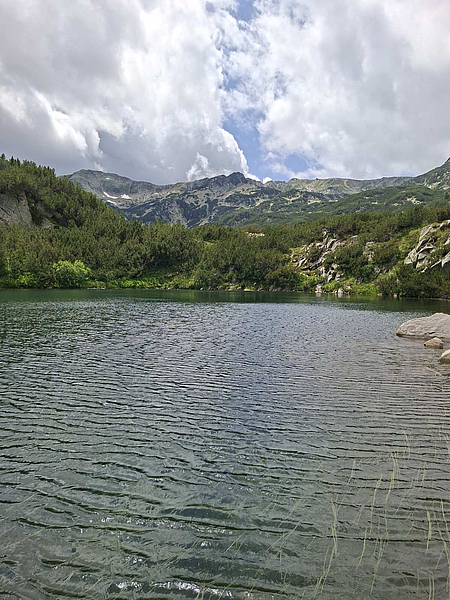
Lake Okoto, Pirin National Park, 22.07.2026
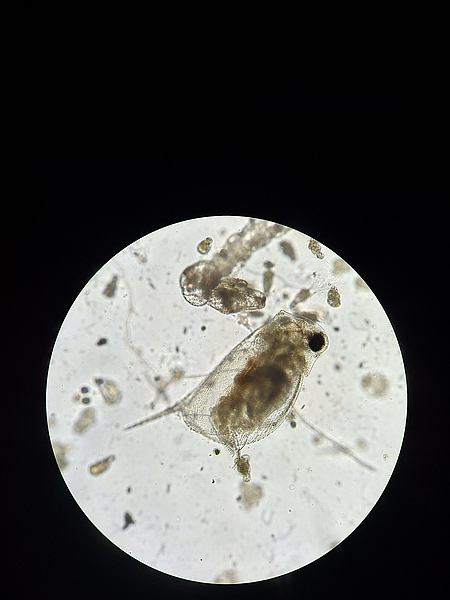
Daphnia Rosea from Lake Okoto in Pirin. Sample taken on 22.07.2026
In alpine limnology water bodies, proportionate investigation means matching sampling intensity and analytical claims to two competing realities: the extreme physical fragility of small high-mountain water bodies and the urgent need for actionable data to manage human pressure. Nowhere in Pirin National Park is this balance more critical than at Lake Okoto.As the lowest and smallest of the Banderishki Lakes only covering roughly 0.26 hectares (2.6 decares) with a maximum depth of 5.5 meters and a volume of just 6,600 m³, Lake Okoto sits barely 600 meters south of Vihren Hut along one of Bulgaria’s busiest mountain trails. Because its silicate bedrock provides minimal chemical buffering and its small water volume offers almost no thermal or dilution inertia, it responds rapidly to both climate warming and shoreline foot traffic.
The approach
Qualitative and quantitative zooplankton samples were collected using a qualitative Apstein-type net with a 55 μm mesh size and an inlet diameter of 16 cm. Quantitative samples were obtained by filtering 50 dm³ of water directly through the Apstein net using a 5-liter bucket, whereas qualitative samples were collected by casting the Apstein net from the littoral zone.
Periphyton samples from the littoral zone, as well as macrozoobenthos samples, were also collected. In situ profiling of the main physicochemical parameters (temperature, pH, dissolved oxygen, electrical conductivity, and total dissolved solids [TDS]) was conducted using specialized instruments: a HANNA dissolved oxygen meter, a HANNA pH meter, and a multiparameter probe for spectral water analysis, specifically targeting chlorophyll-a. For precise analysis of nutrients such as nitrates, nitrites, and phosphates, water samples were transported under refrigerated conditions and analyzed at the accredited laboratory testing in accordance with international standards BDS EN ISO 10304-1:2009 (ion chromatography) and BDS EN ISO 6878:2005 (spectrophotometry). Field measurements reveal the following physicochemical values: an epilimnetic temperature of 19.6 °C, a pH of 8.48, and oxygen supersaturation of up to 138%, which indicates heightened photosynthetic activity. Biological analysis confirms the presence of cold-stenothermic species, while simultaneously signaling advanced mesotrophication. The results highlight the pressures of global warming and increased tourist traffic, which accelerate the biological aging of the water body through nutrient input.
Deliverables
Baseline Ecological Assessment Report for Lake Okoto establishing reference physicochemical and hydrobiological conditions for a Type L1 silicate lake.
Accredited Nutrient Analysis Dataset (nitrates, nitrites, phosphates) validated under BDS EN ISO 10304-1:2009 and BDS EN ISO 6878:2005 standards.
Taxonomic Inventories of zooplankton, littoral periphyton, and macrozoobenthos documenting coexisting cold-stenothermic and mesotrophic indicator taxa.
Trophic Diagnostic Benchmark centered on the Rotifer-Cladocera-Copepoda (RCC) index (40% baseline) to detect early productivity shifts missed by dissolved nutrient assays alone.
Proportionate Low-Impact Field Sampling Protocol tailored to small, poorly buffered alpine water bodies to prevent sampling-induced disturbance.
Multi-Season and Multi-Annual Sentinel Monitoring Plan tracking temperature, dissolved oxygen, pH, chlorophyll-a, and zooplankton community structure.
Visitor and Erosion Management Brief for the Pirin National Park Directorate targeting footpath stabilization, shoreline access buffers, and organic litter prevention along the Vihren Hut corridor.
Decision value
The primary decision value of these conclusions lies in preventing a classic conservation blind spot: a chemical "false negative." If Pirin National Park managers relied solely on standard hydrochemical thresholds where low conductivity (24 µS/cm), low TDS (12 ppm), and nutrients below laboratory quantification limits make Lake Okoto appear pristine but they would miss an ecological shift already underway. By integrating biological community structure with morphometric context, your conclusions convert a single-campaign baseline into an actionable, risk-calibrated governance tool.
1. Eliminating Chemical Blind Spots Through Biological Early Warning In poorly buffered, ultra-oligotrophic granite lakes, incoming nutrients are rapidly assimilated by primary producers rather than accumulating in the water column. Your findings demonstrate that dissolved nitrate, nitrite, and phosphate values below quantification limits do not guarantee oligotrophic stability. Instead, the 40% RCC(Rotifera, Cladocera, Copepoda) Kozuharov, Stanachkova et al. (2013) index (driven by 60% Rotifera, 30% Cladocera, and 10% Copepoda), combined with pH 8.48 and high oxygen saturation at 19.6 °C, gives decision-makers proof that biological productivity is already responding to environmental forcing before routine water chemistry flags a violation. 2. Defining an Actionable "Window of Opportunity" The coexistence of cold-stenothermic and oxygen sensitive indicators (Daphnia rosea, Ephemeroptera, Trichoptera) alongside mesotrophic and eurythermal littoral taxa (Brachionus spp., Keratella cochlearis, Bosmina longirostris, Chydorus sphaericus, Odonata, Pisidium, Lymnaea) proves that Lake Okoto is in a transitional state, not a collapsed one. For conservation authorities, this distinction is critical: • It signals that the lake still retains its native alpine biodiversity and natural recovery capacity. • It justifies immediate, low-regret preventative measures some of which are stabilizing eroded footpaths along the Vihren Hut corridor and preventing organic litter inputs, while low-cost visitor management can still reverse the trajectory. 3. Preventing Premature or Disproportionate Interventions By explicitly framing the results as a baseline assessment rather than conclusive proof of permanent mesotrophication, the conclusions establish clear guardrails against over-interpreting a single summer snapshot. Park authorities are given a solid rationale to prioritize non-invasive catchment and trail management while avoiding costly or ecologically disruptive interventions until multi-season and multi-year data confirm whether these shifts are interannually persistent.
Kozuharov, D., Stanachkova, M. et al. 2013. RCC Index for Trophic State Assessment. – Journal of Hydrobiology, vol. 42, pp. 12–25.
Need a comparable assessment?
Send the water body, location, concern, and intended decision. We will confirm the appropriate first scope.